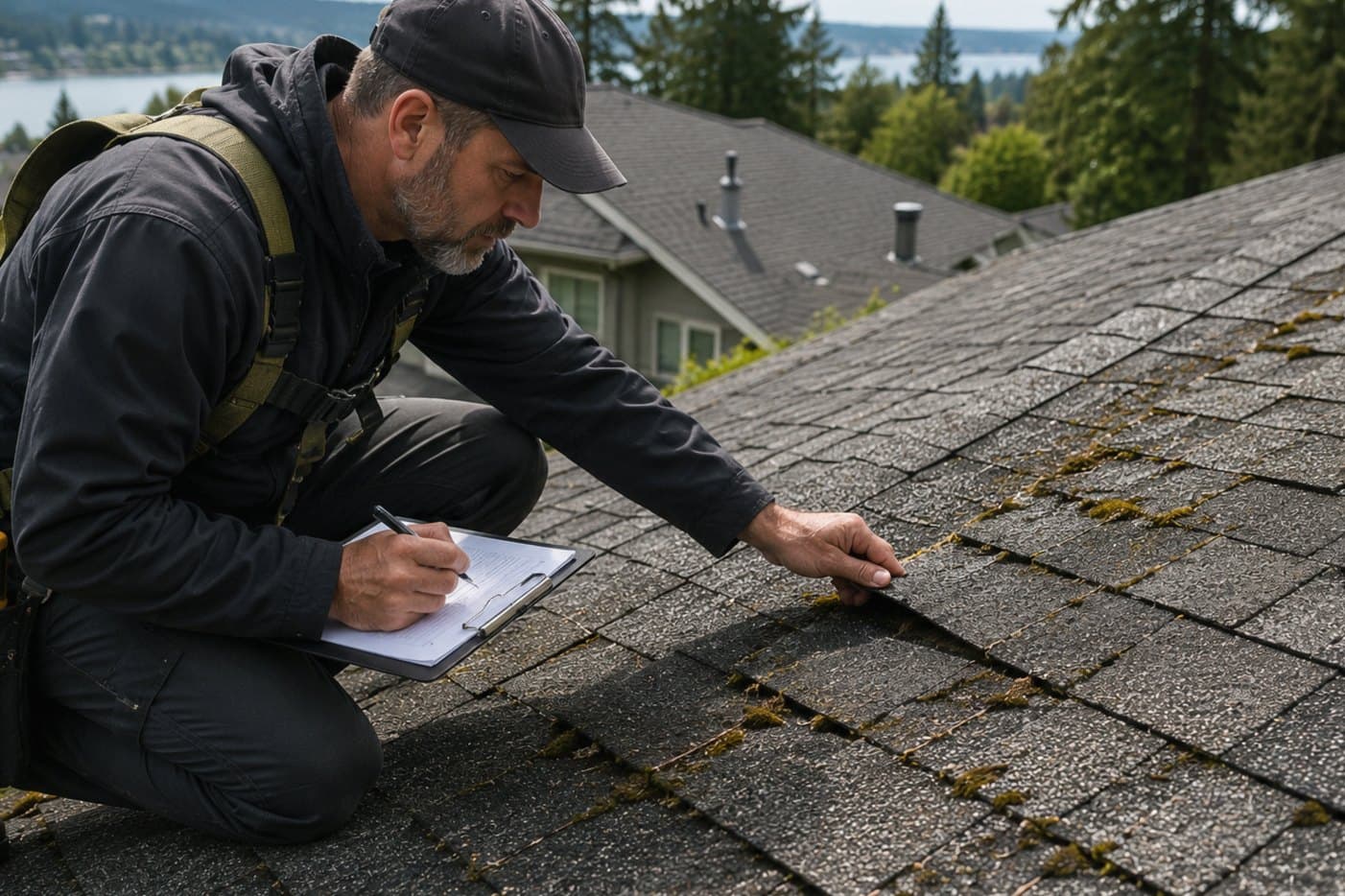
A roof inspection can help determine whether isolated damage needs repair or the roofing system is approaching replacement.
A roof leak does not automatically mean you need a new roof.
Sometimes the problem is limited to a few damaged shingles, a flashing detail, or one vulnerable area around a vent or chimney. Those problems may be repairable.
The decision changes when damage is no longer isolated.
If leaks keep returning, shingles are failing across several areas, or the roof deck itself is showing signs of trouble, another small repair may only postpone a larger project.
For Seattle-area homeowners, the goal is not to replace a roof too early. It is to recognize when repeated repairs are no longer solving the underlying problem.
Here are eight signs worth paying attention to.
1. Leaks Keep Coming Back
One isolated leak can often be traced to a specific problem.
Maybe flashing has failed around a chimney. A roof vent may need attention. A few shingles may have been damaged by wind or debris.
That is very different from a roof that develops leaks in multiple areas or needs repairs every rainy season.
Recurring leaks suggest the problem may extend beyond one damaged spot.
Water can also travel along roof decking, rafters, or other materials before becoming visible inside the house. The stain on the ceiling is not always directly below the place where water entered.
If you keep repairing leaks but new ones continue to appear, it is time to look at the condition of the entire roofing system.
2. Shingles Are Curling, Cracking, or Missing
Asphalt shingles should generally lie flat and create a consistent protective surface.
When shingles begin curling at the edges, cracking, lifting, or disappearing from different parts of the roof, they may no longer be protecting the home the way they were designed to.
A few damaged shingles after a wind event may only require repair.
Widespread deterioration is different.
If multiple roof slopes show curling, cracking, or missing shingles, replacement may make more sense than repeatedly patching individual areas.
Pay particular attention to exposed sections of the roof that receive more sun, wind, or weather.
3. You Are Seeing Significant Granule Loss
The small granules on asphalt shingles are part of their protective surface.
Some loose granules are normal, especially with a newer roof or after normal weather exposure. The concern is heavy or widespread loss.
You may notice:
bald areas on shingles;
uneven coloring across the roof;
larger amounts of granules collecting in gutters;
shingles that look thin or worn.
Granule loss becomes more significant when it appears together with cracking, curling, leaks, or an older roof.
One symptom rarely tells the whole story.
Several symptoms together usually provide a clearer picture.
4. Flashing Is Failing in Several Areas
Some of the most vulnerable parts of a roof are not the large open sections.
They are the transitions.
Chimneys, vents, skylights, walls, valleys, and other penetrations depend on properly installed flashing to keep water out.
A single flashing problem may be repairable.
But when an older roof has several deteriorated flashing areas along with worn shingles, the question becomes larger than one repair.
Replacing an aging roof also gives the contractor an opportunity to address these details as part of the complete roofing system rather than treating them one at a time.
5. The Roof Deck Feels Soft, Looks Damaged, or Is Sagging
This is a more serious warning sign.
The roof deck is the structural surface underneath the roofing materials. If moisture has reached the decking and caused deterioration, the problem is no longer only cosmetic.
Possible warning signs include:
visible sagging;
soft or weakened sections;
staining in the attic;
deteriorated wood;
persistent moisture;
sections that no longer appear straight or even.
A sagging roof should not be treated as a simple shingle problem.
The underlying structure needs to be evaluated.
During a full roof replacement, removing the old roofing materials allows damaged decking to be identified and repaired before the new system is installed.
6. Moss and Moisture Problems Keep Returning
Moss is common on roofs in the Pacific Northwest, especially where surfaces remain shaded and damp.
Seeing moss does not automatically mean the roof needs replacement.
The bigger concern is repeated moisture retention.
Thick moss can hold water against the roof surface. Leaves, pine needles, and other debris can create similar conditions by slowing drainage and keeping sections of the roof wet.
If moss keeps returning on an older roof, look at the bigger picture:
Are shingles already deteriorating?
Are gutters staying clogged?
Is debris collecting in valleys?
Are shaded sections staying wet?
Is flashing in good condition?
Has the roof already developed leaks?
Moss is one clue.
The condition underneath it matters more.
7. Repairs Are Starting to Add Up
One repair can be a sensible way to extend the life of an otherwise healthy roof.
Five repairs over several years tell a different story.
There comes a point when repeatedly fixing isolated sections becomes less practical because the rest of the roof continues to age at the same time.
Think about the repair history.
Has the same area leaked more than once?
Have different sections needed attention recently?
Are you replacing shingles in one location while another section is beginning to fail?
Is flashing being repaired on a roof that already has widespread shingle wear?
When repairs become a routine expense rather than an occasional fix, comparing that cost with replacement becomes worthwhile.
8. The Roof Is Older and Showing Several Signs at Once
Age alone should not determine whether a roof gets replaced.
A well-performing older roof may still have useful life remaining.
But age becomes more important when it appears together with other problems.
For example, an older asphalt roof with flat, intact shingles, sound flashing, dry decking, and no leaks is very different from an older roof with granule loss, recurring leaks, damaged flashing, moss, and cracked shingles.
The second roof is giving you multiple pieces of information.
That is usually when a professional inspection becomes more valuable than simply making another small repair.
If you are unsure where your roof falls in its lifespan, see our guide on how long a roof lasts in Seattle:
/blog/how-long-does-roof-last-seattle
When Roof Repair Usually Makes Sense
Roof repair can be a good option when the damage is localized.
Examples include:
a small number of missing shingles;
one damaged flashing area;
a limited leak with a clearly identified source;
minor storm or branch damage;
a roof that is otherwise in good condition.
In those situations, replacing the entire roof may not be necessary.
The important question is whether the repair addresses the actual cause of the problem.
Covering a symptom without finding where water is entering will usually lead to another call later.
When Replacement Becomes the Better Conversation
Replacement becomes more reasonable when several components are deteriorating together.
That may include widespread shingle wear, repeated leaks, damaged flashing, failing roof decking, recurring moisture problems, or repairs in multiple areas.
At that point, a new roof allows the contractor to inspect what is underneath the existing roofing and rebuild the system from the deck up where needed.
Fine Element Construction's roofing process includes:
full roof inspection and assessment;
tear-off and debris removal;
decking repair as needed;
ice and water shield;
synthetic underlayment;
shingle installation;
flashing replacement;
final walkthrough.
For more information, link roof replacement and roofing services to:
/services/roof-replacement
What Should Be Checked During a Roof Inspection?
A useful roof assessment should look beyond one visible defect.
The inspection should consider the condition of the shingles, flashing, valleys, roof penetrations, gutters, drainage, ventilation, and accessible roof decking.
The attic can also provide useful information.
Moisture stains, darkened wood, wet insulation, or signs of past leaks can help show whether water has made its way through the roofing system.
This is especially helpful when the exterior problem is not obvious.
The purpose of the inspection should be to answer a practical question:
Is this an isolated repair, or is the roof failing in enough places that replacement makes more sense?
Repair vs. Replacement: Think About the Whole Roof
Homeowners often focus on the most visible problem.
A missing shingle catches your eye. A stain appears on the ceiling. Moss shows up on one roof slope.
Those details matter, but they need context.
The condition of the rest of the roof matters just as much.
A newer roof with one damaged section may be a good repair candidate.
An older roof with several different problems may be telling you that its components are reaching the end of their useful life together.
That is why a good assessment looks at the roof as a system rather than trying to sell the same solution for every house.
Roof Repair or Replacement in the Greater Seattle Area
Seattle-area weather gives small roof problems plenty of opportunities to become bigger ones.
Long wet periods, moss, tree debris, wind, and normal material aging can all expose weak points over time.
That does not mean every roof problem requires replacement.
It means it is worth understanding what is actually happening before water reaches the interior of the home.
Fine Element Construction provides residential roofing and roof replacement services in Seattle, Kirkland, Bellevue, Redmond, Mercer Island, Sammamish, and the Greater Seattle Area.
If you are seeing repeated leaks, damaged shingles, granule loss, sagging, deteriorated flashing, or other signs of roof wear, start with an inspection.
The right answer may be a focused repair.
Or the inspection may show that replacement is the more practical long-term solution.
The important part is knowing the difference before the next wet season finds the weak spot.