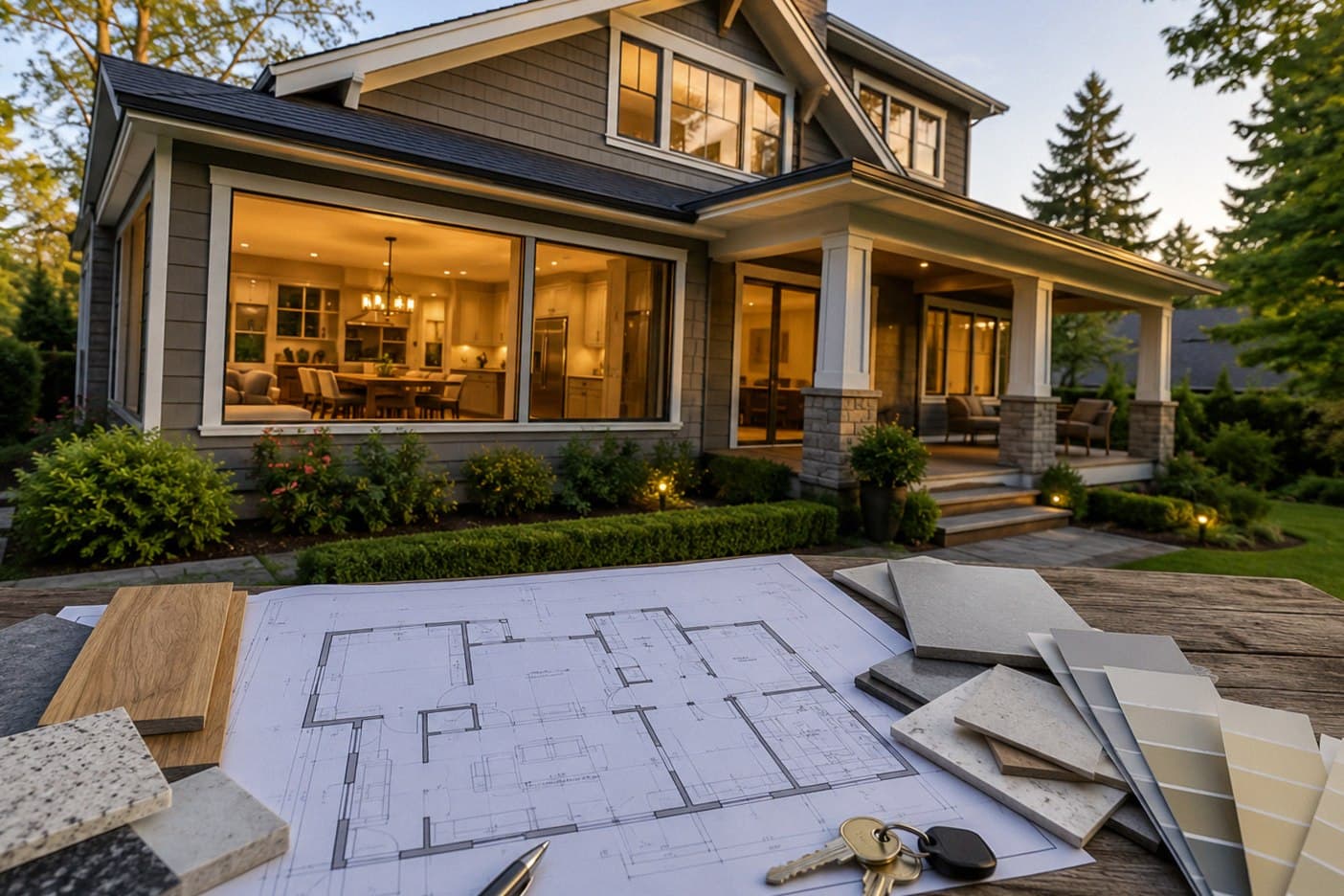
Should You Renovate or Move? An Eastside Decision Guide
Published August 31, 2026
The renovate-or-move decision usually comes down to location, space potential, renovation scope, selling costs, financing, and whether the current home can realistically become the home you need.
Should You Renovate or Move? An Eastside Decision Guide
If you like where you live but no longer like how your house works, renovation is usually worth investigating before you move.
If the location itself is wrong, the lot cannot support what you need, or the house would require major changes and still fall short, moving may make more sense.
That is the short answer.
The harder part is figuring out which situation you are actually in.
For homeowners in Kirkland, Bellevue, Redmond, Mercer Island, Sammamish, Seattle, and nearby Eastside communities, the decision is rarely just “What will remodeling cost?”
Moving has costs too.
So does staying in a house that no longer fits your family.
The best decision comes from comparing the two paths honestly rather than looking only at the renovation estimate or the price of another house.
Fine Element Construction works with homeowners on kitchens, bathrooms, full-home renovation, structural changes, roofing, decks, restoration, and other residential remodeling projects across the Greater Seattle Area.
Start With the One Thing You Cannot Remodel: Location
You can change a kitchen.
You can rebuild a bathroom.
You can open walls, add storage, change flooring, update lighting, replace old finishes, and sometimes rework a large part of the home.
You cannot remodel the neighborhood.
That makes location the first question.
Do you still like living where you are?
Think about the commute.
Schools.
Neighbors.
Street.
Lot.
Trees.
Walkability.
Access to parks.
Distance from family.
The way the neighborhood feels.
If you would buy the same lot again today, renovation deserves a serious look.
If you have wanted to leave the neighborhood for several years, a beautifully remodeled kitchen probably will not solve the real problem.
Ask Whether the House Can Actually Become What You Need
The next question is not whether the house needs work.
Most houses can be improved.
The better question is whether it has the potential to solve the problems that matter to you.
Maybe the kitchen is too small but there is a wall that could be reconsidered.
Maybe the primary bathroom has a poor layout but enough square footage to work much better.
Maybe several small rooms could be reorganized.
Maybe storage is the real problem.
Maybe the home needs a deck or better connection to the backyard.
Those are often renovation problems.
But some needs are harder.
If you need significantly more bedrooms, a much larger lot, a different school location, substantially more parking, or a home that functions on one level, remodeling may not get you all the way there.
Do not ask only, “Can we renovate this?”
Ask, “After we renovate it, will this actually be the house we want?”
Make a List of What Is Not Working
Before comparing homes online, write down why you are considering moving.
Be specific.
“The house feels old” is not very useful.
“The kitchen is cut off from the living room” is useful.
“We need another bathroom” is useful.
“There is almost no storage” is useful.
“The primary bathroom is too small” is useful.
“We cannot comfortably entertain here” is useful.
“The deck is failing” is useful.
“We need a dedicated office” is useful.
Once the problems are on paper, separate them into two groups.
Problems renovation could potentially solve.
Problems renovation cannot solve.
That simple exercise often makes the decision much clearer.
Renovate If the Problems Are Mostly Inside the House
Renovation tends to make more sense when you like the location and the biggest frustrations are related to the house itself.
That may include an outdated kitchen.
Poor bathroom layouts.
Old finishes.
Insufficient storage.
Closed-off rooms.
Poor lighting.
Old flooring.
An underused area of the home.
An aging deck.
Outdated electrical or plumbing systems that are already due for attention.
In these situations, moving can mean giving up a location you like just to buy another house that may eventually need its own remodeling.
That deserves some thought.
Move If the Problem Is Bigger Than the Remodel
There are also situations where remodeling becomes an expensive way of avoiding an obvious move.
Maybe the house is simply too small and there is no practical expansion path.
Maybe the lot no longer works for your lifestyle.
Maybe you need to be in another part of the Eastside.
Maybe stairs have become a long-term concern and the home cannot realistically be reorganized for main-floor living.
Maybe you need substantially more bedrooms.
Maybe the commute has changed.
Maybe the family wants a completely different type of property.
A remodel should solve a housing problem.
It should not be used to fight against the fundamental limitations of the property.
Compare the Cost of Moving With the Cost of Remodeling
This is where homeowners sometimes compare the wrong numbers.
They see a renovation estimate and compare it with the purchase price of another home.
Those are not equivalent.
Moving involves selling one property and buying another.
Depending on the transaction, costs can include real estate commissions or negotiated broker compensation, Washington real estate excise tax on the sale, title and escrow costs, preparation or staging, possible buyer concessions, movers, temporary storage, financing costs, inspections, and immediate work on the next house.
For rough early planning, some Seattle-area real estate professionals use around 8–10% of the sale price as a broad estimate of total selling and moving costs once multiple expenses are counted.
That is not a fixed Washington fee and it will not apply exactly to every homeowner.
The real number needs to be calculated for your property.
But the point is important: moving is not free.
An Eastside homeowner deciding between a substantial remodel and a move should compare the remodel budget with the true net cost of selling, buying, moving, and preparing the next home.
Calculate What You Actually Keep After Selling
The listing price is not the amount you take with you.
Start with a realistic sale value.
Then subtract the mortgage payoff.
Then estimate transaction costs.
Washington also has a real estate excise tax that generally applies to real property sales and is usually paid by the seller.
Broker compensation should be based on the agreements involved in the transaction rather than assumed as one universal percentage.
Then consider title, escrow, preparation, possible repairs or buyer credits, moving, storage, and temporary housing if needed.
What remains is much closer to the number you can actually use toward the next home.
This calculation can make the renovate-or-move decision look very different.
Remember That the Next House May Need Work Too
It is easy to compare your current home at its worst with another home at its best.
You know every problem in your current house.
The house you are viewing for 30 minutes is still mostly unknown.
A different home may need paint.
Flooring.
A bathroom remodel.
A kitchen update.
Roof work.
New appliances.
Lighting.
A deck.
Window work.
Storage improvements.
Electrical updates.
Those costs should be part of the comparison.
Moving from an outdated house into another house that needs $100,000 of work is very different from moving into something that truly solves the problem.
Compare finished-home to finished-home whenever possible.
Look at Your Mortgage Before Making the Decision
Financing can change the math dramatically.
If your current mortgage terms are significantly better than what would be available on another purchase, selling may increase the cost of owning the next home even if its purchase price looks manageable.
On the other hand, funding a large renovation also has a cost.
Homeowners may use savings, home equity, renovation financing, or another structure depending on their situation.
Fine Element Construction does not provide financial advice, so this part should be reviewed with the appropriate lender or financial professional.
But it belongs in the decision.
Compare monthly housing cost after renovation with monthly housing cost after moving.
The purchase price alone does not tell the whole story.
Look at the House as a Whole
A kitchen remodel can be the right project.
But if the roof, plumbing, electrical system, bathrooms, windows, deck, and flooring all need attention too, the decision becomes bigger.
Before investing heavily in one room, consider the condition of the whole house.
What will likely need work over the next five to ten years?
This does not automatically mean you should move.
In fact, coordinating several connected projects can sometimes make more sense than repeatedly opening and repairing the same areas of the home.
But you need to know what you are buying into.
A whole-home view helps prevent the kitchen budget from becoming the only number in the conversation.
Older Eastside and Seattle Homes Need Extra Investigation
Older homes can be excellent renovation candidates.
They often have established neighborhoods, mature landscaping, solid locations, and details that are difficult to reproduce in new construction.
They can also contain surprises.
Older plumbing.
Electrical work.
Uneven floors.
Past remodels.
Moisture issues.
Structural changes.
Outdated insulation.
Unpermitted work.
Materials that need special handling.
Before making a major renovate-or-move decision around an older home, it helps to understand the likely condition behind the visible finishes.
The goal is not to assume the worst.
It is to avoid building a financial decision around an unrealistically simple project.
What Would You Change If You Stayed?
Imagine you have already decided to stay.
Now describe the project you would actually want.
Do not limit yourself to cosmetic changes yet.
Would you remodel the kitchen?
Would you open it to an adjacent room?
Would you rebuild the primary bathroom?
Would you improve a guest bathroom?
Would you change flooring throughout the main level?
Would you add storage?
Would you replace or rebuild the deck?
Would you improve lighting?
Would several rooms need to be renovated together?
This gives you a realistic renovation scenario to compare with moving.
Without that scope, “renovate” is too vague to price or evaluate.
What Would You Buy If You Moved?
Now do the opposite.
Describe the home you would actually buy.
Not an imaginary perfect house.
A realistic one.
Which city?
How many bedrooms?
How many bathrooms?
How much square footage?
What age?
What school area?
What lot?
What commute?
What condition?
Would you need a bigger mortgage?
Would you accept an older kitchen?
Would you still remodel something after moving?
How much would a realistic replacement property cost?
This is the other half of the comparison.
The decision becomes much easier when both options are concrete.
Do Not Ignore the Emotional Cost of Moving
Financial spreadsheets are useful.
Life still happens outside the spreadsheet.
Moving means packing.
Showings.
Inspections.
Negotiations.
Closing.
Changing addresses.
Utility transfers.
Moving trucks.
Children changing routines.
Possibly changing schools.
Learning a new neighborhood.
And then unpacking everything again.
For some families, none of this is a problem.
They are ready for a new chapter.
For others, staying in the neighborhood they already love has real value.
That value does not need to be reduced to a dollar figure, but it deserves to be included in the decision.
Renovation Has Disruption Too
Renovation is not the easy alternative.
Construction can be noisy.
Dust protection is necessary.
A kitchen may be unavailable.
A bathroom may be out of service.
Trades need access to the home.
Materials need to arrive.
Inspections may need to happen.
Unexpected conditions can change part of the work.
For larger renovations, temporary living arrangements may sometimes be worth considering.
Be honest about your tolerance for construction.
A homeowner who loves the finished idea but cannot reasonably live through the process should plan for that before work begins.
Think About How Long You Plan to Stay
Time horizon matters.
If you expect to move within a short period anyway, a major customized renovation may not make sense.
If this is the home you expect to live in for another ten, fifteen, or twenty years, the calculation can be different.
You get to use the improvements.
A better kitchen affects thousands of meals.
A better bathroom affects every morning.
More functional storage reduces everyday frustration.
A better layout changes the way the house feels.
Renovation value is not only resale value.
It is also the value of living in the improved home.
Do Not Remodel Only for Resale
Resale matters, but it should not control every decision unless you are actually preparing to sell.
A homeowner planning to stay for years should design primarily around how the household lives.
That does not mean making wildly impractical choices.
It means there is room to prioritize comfort and function.
A larger shower may matter more to you than a tub.
More pantry storage may matter more than decorative shelving.
A better island layout may matter more than following a kitchen trend.
The strongest renovations usually solve real problems first.
Consider Whether You Are Underusing Existing Space
Some homeowners think they need a larger house when they actually need a better layout.
Look at spaces that are not working hard enough.
Formal dining rooms.
Oversized hallways.
Closed-off kitchens.
Unused tubs.
Poorly organized closets.
Awkward bonus rooms.
Large laundry areas with poor storage.
Basements.
Unused corners.
This does not mean every wall should come down.
It means square footage should be judged by usefulness, not just by the number printed on the listing.
A well-planned renovation can sometimes make the same house feel substantially larger without adding square footage.
When an Addition Enters the Conversation
Sometimes the house almost works.
It simply needs more space.
At that point, homeowners may start comparing an addition with moving.
An addition is a different level of project from interior remodeling.
It may involve design work, structure, foundation, exterior work, roofing, mechanical systems, permits, and a longer construction process.
The lot and jurisdiction also matter.
An addition should therefore be studied as its own option rather than casually added to an interior renovation estimate.
In some situations it can make sense.
In others, the cost and complexity may push the decision toward moving.
Look at Renovation in Phases
You may not have to renovate everything at once.
Some homes have a logical sequence.
Kitchen and main-floor work first.
Primary bathroom later.
Deck later.
Exterior work on its own schedule.
Phasing can make the financial side easier to manage.
But it should still be planned as part of a larger picture.
You do not want to finish new flooring and then tear it up for plumbing work that could have been anticipated.
You also do not want to build a kitchen layout that conflicts with a future structural change.
A long-term plan can be valuable even when construction happens in stages.
When a Full Renovation Makes More Sense
Sometimes several rooms are connected enough that renovating them together is cleaner than treating each as an isolated project.
A kitchen layout change may affect the dining room.
New flooring may continue through the whole main floor.
Electrical work may affect several spaces.
Wall removal may change lighting and HVAC planning.
A primary suite project may involve the bedroom, bathroom, closet, and hallway together.
In those situations, a broader renovation plan can reduce duplicated work and create a more consistent finished home.
The scope should follow how the house actually works.
Not arbitrary room boundaries.
Renovate If You Still Love the Property
There is one question that often cuts through the noise.
If this house already had the kitchen, bathrooms, layout, storage, and finishes you wanted, would you still want to move?
If the answer is no, renovation deserves serious consideration.
You probably do not hate the house.
You hate the current version of the house.
Those are different problems.
Move If Even the Perfect Remodel Would Not Be Enough
Now reverse the question.
Imagine the renovation is finished perfectly.
Would you still wish the house had a larger yard?
Would you still dislike the commute?
Would you still want another school district?
Would you still need more bedrooms?
Would you still want a one-level home?
Would you still feel like the neighborhood is wrong?
If the answer is yes, remodeling may only postpone the move.
That is useful information too.
A Simple Renovate-or-Move Test
A homeowner is generally a stronger candidate for renovation when:
You like the location.
You like the property.
The house has enough basic space or realistic potential.
The problems can actually be solved through remodeling.
The renovated home would meet your needs for years.
The renovation budget makes sense compared with buying the replacement home you want.
Moving may be the stronger option when:
The location no longer works.
The lot cannot meet your needs.
You need substantially more space than the house can reasonably provide.
Your long-term accessibility needs conflict with the structure.
The renovation would become extremely extensive and still involve major compromises.
You already expect to leave the area soon.
Neither list makes the decision automatically.
It simply helps identify which direction deserves more investigation.
Run Both Scenarios Before Committing
The best approach is to price both realities.
For the renovation scenario, establish a realistic project scope and obtain enough information to understand the likely investment.
For the moving scenario, estimate the expected sale proceeds after transaction costs and mortgage payoff.
Then estimate the purchase price, financing, closing costs, moving costs, and likely improvements to the replacement home.
Put the two results beside each other.
Not because the cheaper option automatically wins.
Because you should know what you are choosing.
Questions to Ask Before Renovating
Before deciding to stay, ask:
Can the existing house realistically support the layout we need?
Which problems would remain after the renovation?
Are there major systems likely to require work soon?
Is there enough budget for the actual project rather than just the visible finishes?
Would we still like this home five or ten years after the remodel?
Can the work be phased logically if needed?
These questions help separate a strong renovation candidate from a house that is being pushed beyond what makes sense.
Questions to Ask Before Moving
Before deciding to sell, ask:
What would our home realistically sell for?
What would we actually net after the mortgage and selling costs?
What does the replacement home we want actually cost?
What mortgage payment would that create?
How much work would the next home still need?
Are we moving because the property is wrong or because several rooms are outdated?
Would we regret leaving this neighborhood after the excitement of buying another house wears off?
These questions make the moving option more concrete.
Renovate or Move on the Eastside?
There is no universal answer.
For one Kirkland homeowner, rebuilding the kitchen, primary bathroom, and main-floor layout may create exactly the home they want without giving up their neighborhood.
For another family, the real need may be a larger property in a different part of the Eastside.
Both can be good decisions.
The important thing is to identify the problem before choosing the solution.
Fine Element Construction provides residential remodeling and renovation services across Kirkland and the Greater Seattle Area, including kitchen remodeling, bathroom remodeling, full-home renovation, structural and layout work, decks, roofing, and restoration.
If renovation is one of the options you are considering, start by defining what the current house would need to become.
Then compare that real project with the real cost and lifestyle change of moving.
That is a much better decision than comparing an unfinished home with a perfect listing photo.