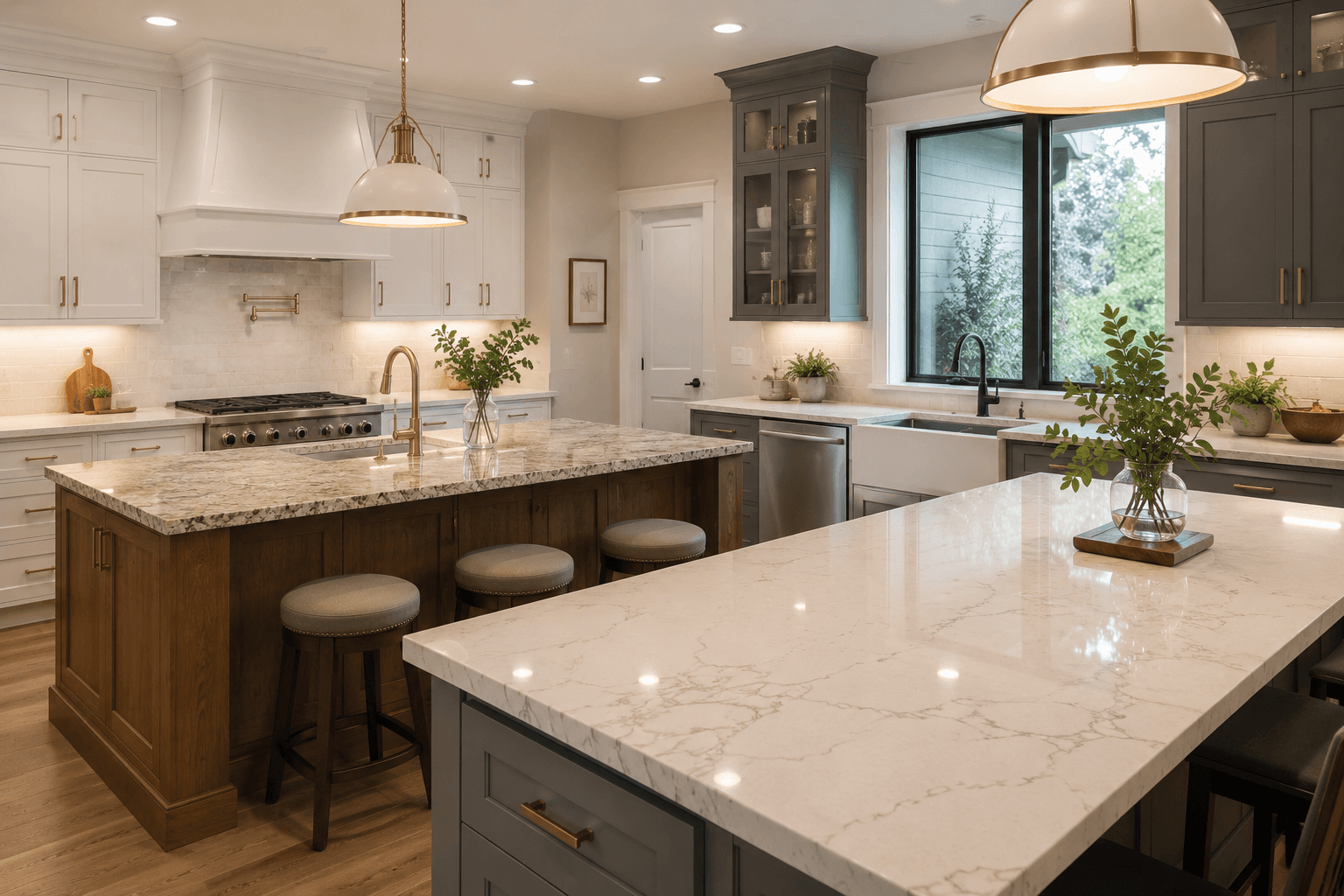
Quartz vs. Granite Countertops: Which Is Right for You?
Published August 5, 2026
Quartz and granite can both work beautifully in a kitchen remodel when the countertop material fits the layout, cabinets, lighting, maintenance needs, and daily use.
* Quartz vs. Granite Countertops: Which Is Right for You?
* Quartz and granite are two of the most common countertop choices for kitchen remodels. Both look beautiful, add value, and work well in Seattle-area homes when chosen for the right reasons.
* The difference depends on how you want the kitchen to look, how much maintenance you want, how the space will be used daily, and how the countertop works with your cabinets, backsplash, lighting, flooring, and overall remodel plan.
* For homeowners in Seattle, Kirkland, Bellevue, Redmond, Mercer Island, Sammamish, and the Eastside, the best countertop is not always the most expensive. It is the one that fits the home, kitchen layout, design style, and how the family uses the space.
* Fine Element Construction helps homeowners plan kitchen remodels with cabinets, countertops, backsplash, lighting, flooring, appliances, ventilation, plumbing coordination, electrical work, permits, inspections, project management, and final finish details.
* What Is Quartz?
* Quartz countertops are engineered surfaces made with quartz minerals, resins, pigments, and binders. Since they are manufactured, quartz countertops come in a wide range of colors, patterns, and finishes.
* Quartz is popular because it provides homeowners a clean, consistent, low-maintenance surface. It can look like marble, stone, concrete, or a simple solid surface depending on the style selected.
* For many kitchen remodels, quartz is the safer choice when the homeowner wants a polished look without extra maintenance that some natural stone surfaces require.
* Quartz works especially well in modern, transitional, and timeless kitchen designs.
* What Is Granite?
* Granite is a natural stone. Each slab is different, with its own movement, color variation, veining, mineral pattern, and character.
* That natural variation is one of the main reasons homeowners choose granite. No two slabs are exactly the same, so the kitchen can feel more custom and more organic.
* Granite can work well in many kitchen styles, from traditional to transitional to Pacific Northwest-inspired designs with warm wood, natural texture, and stone details.
* Because granite is natural, it usually needs more careful selection. The slab matters. The pattern, movement, color, edge detail, and finish should all be reviewed before approval.
* The Main Difference Between Quartz and Granite
* The simplest difference is this: quartz is engineered for consistency, while granite is natural stone with unique variation.
* Quartz usually offers a more controlled look. Granite offers more natural movement and unique character.
* Quartz is often easier for homeowners who want low maintenance and predictable design. Granite is often better for homeowners who love natural stone and do not mind some maintenance.
* Neither option is automatically better. The right choice depends on the kitchen.
* Appearance and Style
* Quartz can be very consistent. If you want a clean white countertop, soft veining, a marble-look surface, or a modern neutral finish, quartz can be a strong option.
* It is easier to coordinate with cabinets, backsplash, lighting, and hardware because the pattern is more predictable.
* Granite has more natural variation. Some slabs are quiet and subtle. Others are bold and dramatic. That can be a strength if the homeowner wants the countertop to become a design feature.
* In a In a busy kitchen, calmer quartz may feel better. In a kitchen with simple cabinets and quiet tile, a beautiful granite slab can add depth and personality.ntenance
* Maintenance is one of the biggest reasons homeowners compare quartz and granite.
* Quartz is usually easier to maintain because it is designed as a low-maintenance surface. It does not usually need the same sealing routine many natural stones require.
* Granite can also be durable, but it may need sealing depending on the stone, finish, and use. It also needs the right cleaning products so the surface stays in good condition.
* If you want the easiest daily care, quartz is often the more practical choice. If you love natural stone and are comfortable caring for it, granite can still be a strong option.
* Durability
* Both quartz and granite can be durable when they are selected and installed correctly.
* Quartz is strong and works well for everyday kitchen use. It handles normal cooking, cleaning, meal prep, and family routines well.
* Granite is also a strong natural stone and can handle heavy use in many kitchens. The performance depends on the slab, finish, sealing, and how the countertop is maintained.
* With either material, installation quality matters. A good countertop needs proper cabinet support, accurate measurements, clean seams, correct sink cutouts, good edge details, and professional installation.
* Heat and Daily Use
* Kitchens deal with hot pans, appliances, water, spills, cutting boards, cleaning products, and constant daily activity.
* Granite is natural stone often chosen by homeowners who like its strength and heat tolerance. Still, it is smart to use trivets and avoid abusing any countertop surface.
* Quartz is also durable, but it should be protected from excessive heat. Hot pans should not be placed directly on the surface.
* The practical rule is simple: no matter which countertop you choose, use cutting boards, trivets, and normal care. A good kitchen remodel should look beautiful and remain functional for years.
* Stains and Sealing
* Quartz is generally more stain-resistant and easier to maintain because it is engineered and less porous than many natural stones.
* Granite resists stains well when properly sealed and cared for, but natural stone still needs more attention than quartz in many cases.
* This matters in busy kitchens where the countertop sees coffee, wine, oil, sauces, citrus, cleaning products, and everyday spills.
* For a family kitchen, quartz may be the more forgiving option. For a homeowner who values natural stone and is comfortable with sealing and care, granite can still be a good choice.
* Cost Factors
* Quartz vs. granite countertop cost depends on more than the material name.
* Cost can be affected by slab selection, color, pattern, thickness, edge detail, island size, number of seams, sink cutouts, backsplash, fabrication, installation, and if the countertop is part of a larger kitchen remodel.
* A simple quartz countertop may cost less than a premium granite slab. A rare granite slab may cost more than many quartz options. A premium quartz pattern may also cost more than a basic granite.
* The real estimate depends on the actual material and the project scope.
* Kitchen Islands
* Kitchen islands make countertop selection more important because the surface is larger and more visible.
* A large island can show off a beautiful slab but can also make a busy pattern feel overwhelming. If the kitchen already has detailed cabinets, strong lighting, or a decorative backsplash, a calmer countertop may work better.
* Quartz is often a good choice for large islands because the pattern can be more controlled. Granite can also work beautifully when the slab has the right movement and the kitchen design supports it.
* The island countertop should feel connected to the whole kitchen, not like a separate design decision.
* Cabinets, Backsplash, and Lighting
* Countertops should never be chosen alone.
* The right surface depends on the cabinets, backsplash, flooring, wall color, hardware, lighting, and overall style of the home.
* Warm wood cabinets may work beautifully with soft quartz, creamy stone looks, or natural granite. White cabinets may pair well with subtle quartz, clean granite, or a stone surface with gentle movement. Dark cabinets may need a lighter countertop to keep the kitchen from feeling too heavy.
* Lighting also changes how the countertop looks. A slab that looks warm in one room can look cooler under different lighting. That is why countertop selection should happen with the full design in mind.
* Quartz Pros
* Quartz is a strong choice for homeowners who want a clean, low-maintenance kitchen countertop.
* It offers consistent color and pattern options, works with many design styles, and is easier to coordinate with cabinets and backsplash.
* Quartz is especially practical for busy kitchens, family homes, and homeowners who want a polished look without natural stone maintenance.
* It is also a good option when the goal is a timeless kitchen that feels clean, bright, and easy to use.
* Quartz Cons
* Quartz may not have the same natural depth and uniqueness as granite.
* Some quartz patterns can look very realistic, but homeowners who love true natural stone may still prefer granite.
* Quartz also needs protection from excessive heat. Hot cookware should not be placed directly on the surface.
* Another possible downside is that some bold quartz patterns can feel trendy if they are not chosen carefully. A countertop should fit the whole kitchen, not just look good on a sample.
* Granite Pros
* Granite is a strong choice for homeowners who want natural stone character.
* Each slab is unique, and the surface can bring movement, depth, and organic texture into the kitchen.
* Granite can work especially well in homes where natural materials, warm wood, and Pacific Northwest design details are part of the overall style.
* For homeowners who like stone variation and want a countertop that does not look manufactured, granite can be a great option.
* Granite Cons
* Granite usually requires more selection care and maintenance than quartz.
* The slab should be reviewed in person when possible because color and pattern can vary. Some granite may need sealing, and the homeowner should use the right cleaning products.
* Granite can also feel visually busy if the pattern is strong and the kitchen already has detailed cabinets, backsplash, or flooring.
* It is a beautiful material, but it should be selected carefully.
* Which Is Better for Resale?
* Both quartz and granite can support resale when they fit the kitchen and are installed well.
* Buyers usually care about whether the kitchen feels clean, updated, durable, and move-in ready. They also notice the layout, cabinets, lighting, appliances, storage, backsplash, and overall condition.
* Quartz may appeal to buyers who want low maintenance and a modern look. Granite may appeal to buyers who appreciate natural stone and unique slab character.
* The best resale choice is the one that fits the home’s style, neighborhood expectations, and overall kitchen remodel quality.
* Which Is Better for a Busy Family Kitchen?
* For a busy family kitchen, quartz is often the easier choice because it is low maintenance, consistent, and forgiving for daily use.
* That does not mean granite cannot work. Granite can be durable and beautiful in a family kitchen when it is properly sealed and cared for.
* The decision depends on how the family cooks, cleans, entertains, and uses the kitchen every day.
* If low maintenance is the priority, quartz usually has the advantage. If natural stone character is the priority, granite may be worth the extra care.
* Which Is Better for a Premium Kitchen Remodel?
* For a premium kitchen remodel, both materials can work.
* Quartz can create a clean, modern, elegant look with less maintenance. Granite can create a more natural, custom, one-of-a-kind look.
* In high-end kitchens, the countertop should be selected with the cabinets, island design, lighting, backsplash, flooring, and appliance package.
* The material alone does not make the kitchen premium. The full design and installation quality matter more.
* Common Mistakes to Avoid
* One mistake is choosing a countertop from a small sample without thinking about the full kitchen.
* A countertop that looks beautiful on a small piece may look too busy or too flat across a large island.
* Another mistake is choosing the countertop before finalizing cabinet color, backsplash, lighting, and flooring. These materials need to work together.
* It is also a mistake to choose only by trend. Countertops are a major part of the kitchen and should still feel right years later.
* Quartz vs. Granite: The Simple Choice
* Choose quartz if you want a low-maintenance surface, a more consistent look, easier design coordination, and a clean modern kitchen.
* Choose granite if you want natural stone, unique slab movement, organic character, and you are comfortable with a little more care.
* Both can be good choices. The right decision depends on your kitchen, your lifestyle, your maintenance expectations, and your full remodel plan.
* Kitchen Countertop Remodeling in Seattle and the Eastside
* Fine Element Construction provides kitchen remodeling and renovation services across the Greater Seattle Area, including Seattle, Kirkland, Bellevue, Redmond, Mercer Island, Sammamish, and nearby Eastside communities.
* Our team helps with kitchen planning, cabinets, quartz countertops, granite countertops, natural stone surfaces, backsplash, lighting, flooring, appliances, plumbing coordination, electrical work, permits, inspections, project management, and final walkthroughs.
* If you are comparing quartz and granite countertops, the best place to start is the full kitchen design. The countertop should work with the cabinets, island, backsplash, lighting, and the way the kitchen is used every day.
* For a broader regional overview, connect this article with the live Pacific Northwest countertop guide on the site.
* Thinking about remodeling your kitchen? Contact Fine Element Construction to compare countertop options, review your layout, and plan a kitchen that looks good and works every day.