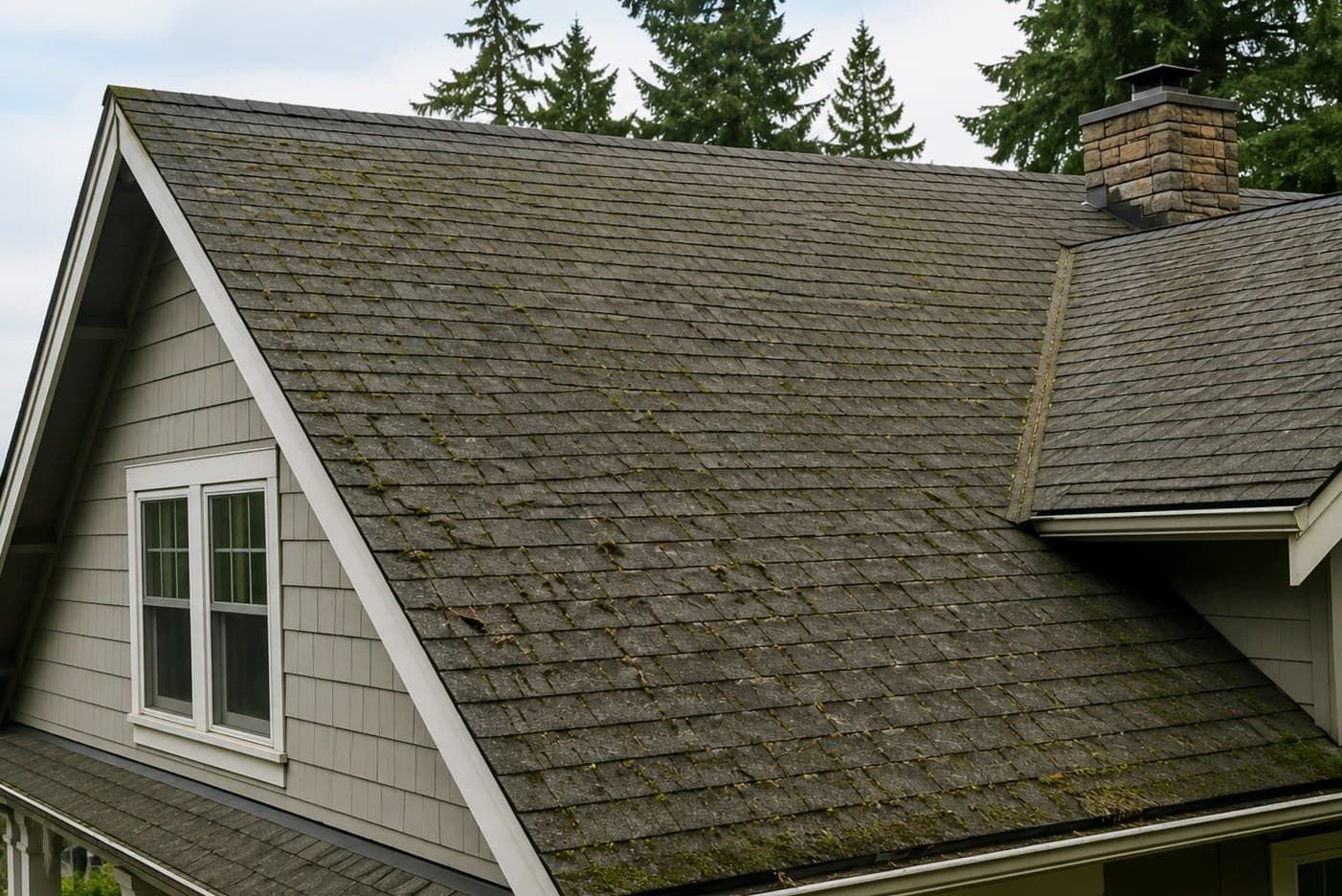
Understanding roof lifespan, maintenance, and replacement needs for homes in the Seattle area.
Most asphalt shingle roofs last about 20 to 30 years, but there is no single replacement age that applies to every Seattle home.
A 20-year-old roof may still be doing its job. Another roof can start having problems much earlier because of poor ventilation, damaged flashing, heavy moss growth, installation issues, or moisture getting where it should not.
Seattle adds another factor: a long wet season.
So if you are trying to figure out how much life your roof has left, the installation date is useful — but the condition of the roof matters more.
How Long Do Asphalt Shingle Roofs Last?
For a typical asphalt shingle roof, 20–30 years is a practical general range.
Three-tab shingles usually fall toward the shorter end. Architectural shingles can often provide a longer service life when they are properly installed and the rest of the roofing system is working as it should.
But a roof is not just shingles.
Its lifespan also depends on the roof deck, underlayment, flashing, ventilation, drainage, installation quality, sun exposure, tree coverage, and maintenance over the years.
That is why two Seattle roofs installed at the same time can age very differently.
Why Seattle Weather Matters
Seattle roofs spend a lot of time wet.
Puget Sound receives most of its annual rainfall between October and March. During that part of the year, shaded sections of a roof may stay damp for long periods, especially around trees or areas with limited sunlight and airflow.
Rain by itself does not mean a roof will fail early. A properly installed roofing system is designed to handle water.
The trouble starts when moisture combines with other problems.
Leaves and needles can collect in valleys and gutters. Moss can spread across shaded shingles. Damaged flashing can let water into vulnerable transitions. Poor attic ventilation can create moisture problems from below the roof instead of above it.
Over time, those conditions can shorten the useful life of the system.
Does Moss Shorten Roof Life?
It can.
Moss is especially common in the Pacific Northwest because it does well in cool, damp, shaded conditions.
A little moss does not automatically mean you need a new roof. The concern is what happens when it becomes thick or stays in place for years.
Moss holds moisture against the roof surface. It can also work into small spaces around shingles and contribute to deterioration.
If moss keeps coming back, do not look only at the moss itself.
Look at the surrounding conditions too:
tree coverage;
debris on the roof;
clogged gutters;
shaded roof slopes;
drainage;
shingle condition;
attic ventilation.
Removing the visible growth without addressing the reason the roof stays damp may only solve the problem temporarily.
What Actually Determines How Long a Roof Lasts?
Age is only one part of the picture.
Several things have a bigger effect than homeowners sometimes realize.
Shingle Type
Not all asphalt shingles are built the same way.
Basic three-tab shingles and heavier architectural shingles have different construction and expected service lives. Product quality matters, but it is still only one part of the roofing system.
Installation Quality
Good materials cannot compensate for poor installation.
Incorrect nailing, poorly installed flashing, weak valley details, improper penetrations, and other installation mistakes can cause problems long before the shingles themselves should be worn out.
Flashing
Many roof leaks begin around transitions rather than in the middle of a large, open roof surface.
Chimneys, skylights, vents, walls, valleys, and other penetrations all depend on properly installed flashing.
When flashing fails, water can get underneath roofing materials even if the surrounding shingles still look relatively good.
Ventilation
The roof also has to manage moisture from inside the home.
Poor attic ventilation can contribute to excess heat and moisture beneath the roof assembly.
A roof should be evaluated as a system, not simply as the layer you can see from the driveway.
Trees and Shade
Mature trees are part of what makes many Seattle neighborhoods attractive, but they can also change how a roof ages.
Branches create shade. Leaves and needles collect in valleys and gutters. Shaded roof surfaces stay damp longer.
Trees do not automatically damage a roof, but homes surrounded by them usually need more attention to debris and moss.
Maintenance
Simple maintenance can make a meaningful difference.
Keeping gutters clear, removing debris, watching for moss, checking flashing, and addressing small problems before they become leaks can help protect the roof you already have.
Signs an Older Roof Needs Attention
You do not have to wait for water to drip from the ceiling before looking at the roof.
Common warning signs include:
missing shingles;
cracked or curling shingles;
shingles that are lifting;
significant granule loss;
recurring moss growth;
damaged flashing;
debris collecting in roof valleys;
repeated leaks;
stains or moisture in the attic;
soft or damaged roof decking;
several problem areas appearing at the same time.
One damaged shingle is different from widespread deterioration.
A localized issue may be repairable. Several problems across an aging roof may point toward replacement.
Is a 15-Year-Old Roof Old?
Not necessarily.
A 15-year-old asphalt roof can still have years of useful life left, depending on the material and its condition.
If the shingles are lying flat, flashing is intact, the roof drains properly, the attic is dry, and there are no widespread signs of deterioration, age alone is not a reason to replace it.
On the other hand, a 15-year-old roof with recurring leaks, major granule loss, extensive moss, damaged flashing, or moisture problems deserves a closer inspection.
The calendar matters.
The condition matters more.
What About a 20-Year-Old Roof?
Around 20 years is a good time to start paying closer attention to an asphalt shingle roof.
That does not mean replacement is automatically due on its twentieth birthday.
Think of 20 years as a point when inspection becomes more valuable.
You want to know whether the roof is still performing well, whether there are isolated repairs to make, or whether several components are reaching the end of their useful life together.
That information is more useful than replacing a roof simply because of its age.
Repair or Replace?
The answer depends on how widespread the problem is.
A repair may make sense when:
the roof is generally in good condition;
damage is limited to one area;
flashing has failed in a specific location;
only a small number of shingles are damaged;
the roof still has substantial useful life remaining.
Replacement becomes more reasonable when deterioration is widespread or repairs keep repeating.
For example, an older roof may have worn shingles on several slopes, repeated leaks, failing flashing, damaged decking, and other signs that the overall system is wearing out.
At that point, fixing one problem at a time may no longer be the best long-term approach.
Fine Element Construction provides roof replacement and roofing services throughout the Greater Seattle Area, including roof inspection, tear-off, decking repair as needed, underlayment, shingle installation, flashing replacement, and final walkthrough.
How to Help Your Roof Last Longer in Seattle
Roof maintenance does not need to be complicated.
Start with the basics.
Keep gutters and downspouts clear so rainwater can move away from the roof.
Remove leaves, branches, and needles before they sit on the roof for months.
Pay attention to shaded areas where moss tends to grow.
Check the roof after major wind events if you notice roofing debris on the ground.
Look inside the attic from time to time for stains, damp wood, or other signs of unwanted moisture.
And do not ignore a small leak because it only appears during heavy rain.
Water can travel before it becomes visible inside the house, which means the stain you see indoors may not be directly below the point where water entered.
What Happens During Roof Replacement?
A proper roof replacement involves more than installing new shingles over an old problem.
Once the existing roofing is removed, the roof deck can be inspected. Damaged areas can be repaired where necessary before the new roofing system goes on.
The installation may include protective membrane in vulnerable areas, synthetic underlayment, shingles, flashing, and other details needed for the particular roof.
This is also the point when problems hidden underneath the old roofing can finally be seen.
Fine Element Construction's roofing process includes roof inspection and assessment, tear-off and debris removal, decking repair as needed, ice and water shield, synthetic underlayment, shingle installation, flashing replacement, and a final walkthrough.
How Much Life Does Your Roof Have Left?
You cannot determine that accurately from age alone.
If you know the roof was installed 18 years ago, that is useful information. But it should be considered alongside what the roof looks like today.
Check:
the condition of the shingles;
flashing around penetrations;
moss and debris;
attic moisture;
ventilation;
signs of past leaks;
condition of the roof deck where visible;
repair history.
A roof that has been well installed and maintained may still be performing properly near the end of a typical lifespan range.
A younger roof with installation or moisture problems may need work much sooner.
Roof Replacement in Seattle and the Eastside
If your roof is getting older, the goal is not to replace it as early as possible.
The goal is to understand its condition before a small problem becomes water damage inside the house.
Fine Element Construction provides roofing and roof replacement services for homeowners in the Greater Seattle Area, including Seattle, Kirkland, Bellevue, Redmond, Mercer Island, Sammamish, and nearby communities.
If you are unsure whether your roof needs a repair, more maintenance, or full replacement, start with an inspection.
A good assessment should tell you what is actually happening with the roof — not simply how old it is.
Learn more about Fine Element Construction roofing and roof replacement services.