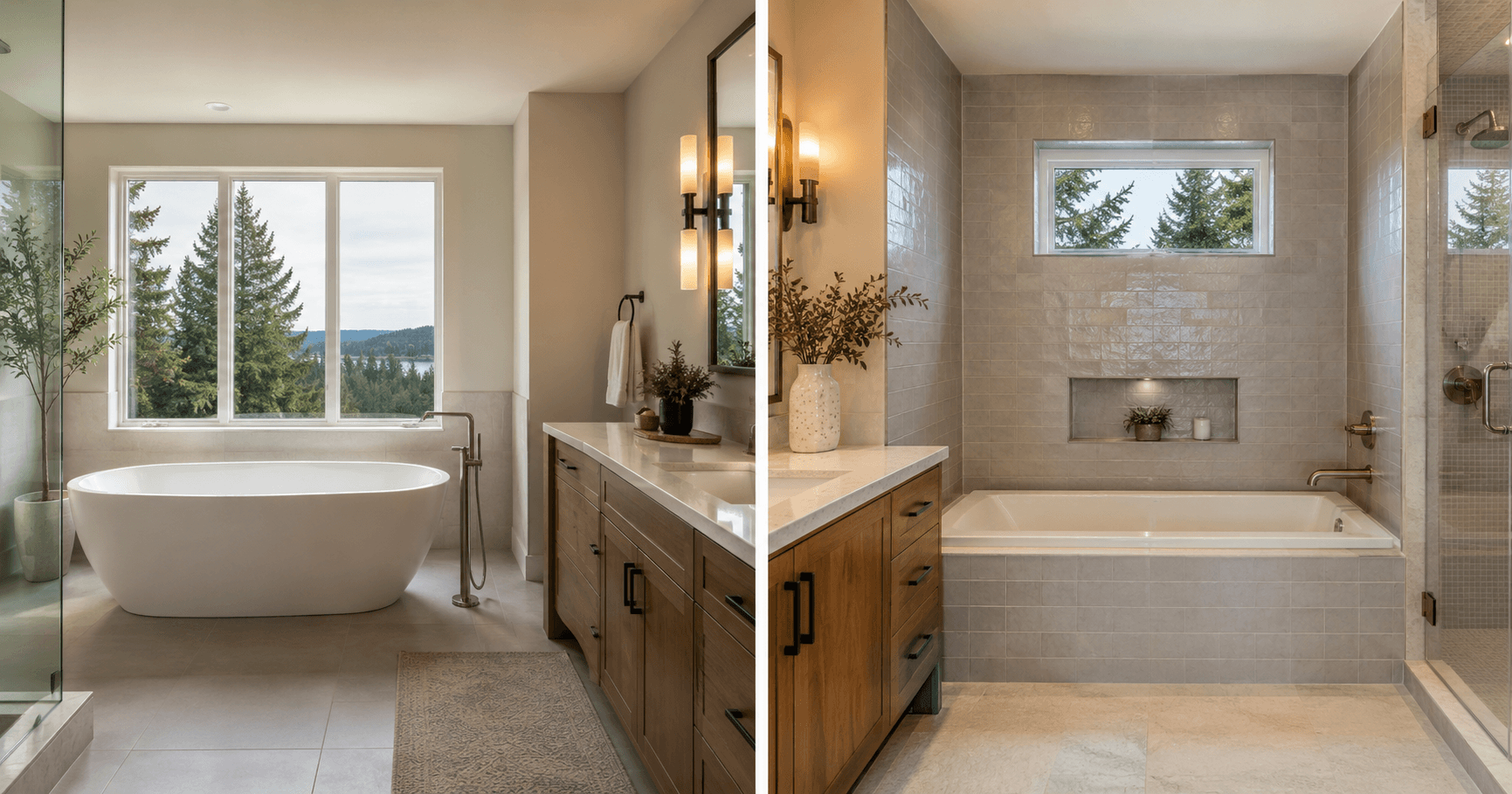
Planning a bathroom remodel in Seattle or the Eastside? Compare freestanding tubs and built-in tubs, including layout, comfort, cleaning, installation, resale, and cost factors.
Freestanding Tub vs. Built-In: Pros, Cons & Costs
A bathtub can change the entire feel of a bathroom remodel. It can make the room feel more relaxing, more finished, and more complete. But not every bathtub works for every bathroom.
Two common options are a freestanding tub and a built-in tub. A freestanding tub stands on its own and is usually treated as a design feature. A built-in tub is installed against walls or inside a surround, often with tile, stone, or another finished surface around it.
For homeowners in Seattle, Kirkland, Bellevue, Redmond, Mercer Island, Sammamish, and the Eastside, the right choice depends on the bathroom size, layout, plumbing location, cleaning needs, resale goals, and the overall scope of the remodel.
Fine Element Construction helps homeowners plan bathroom remodels with practical layout decisions, durable materials, proper plumbing coordination, waterproofing, tile, ventilation, lighting, and final finish details.
What Is a Freestanding Tub?
A freestanding tub is a standalone bathtub that does not need to be built into a wall or surround. It can sit near a window, along a wall, beside a walk-in shower, or in a larger primary bathroom where there is enough space around it.
Freestanding tubs are often chosen for style. They can make a bathroom feel more open, modern, and spa-like.
This type of tub works best when the bathroom has enough room for comfortable access, cleaning space, proper plumbing placement, and a layout that does not feel crowded.
A freestanding tub can look simple, but it still needs careful planning. The drain, tub filler, floor, wall clearances, and surrounding space all matter.
What Is a Built-In Tub?
A built-in tub is installed into a framed area, alcove, platform, or surround. It usually touches one or more walls and may have tile or another finished surface around it.
Built-in tubs can be practical because they use space efficiently. They are common in hall bathrooms, guest bathrooms, family bathrooms, and smaller full bathrooms.
A built-in tub can also be part of a tub-shower combination, which can be useful when the home needs both bathing and shower function in one bathroom.
For many homes, a built-in tub is less about making a design statement and more about function, durability, and efficient use of space.
The Main Difference
The simple difference is this: a freestanding tub is usually a design feature, while a built-in tub is usually a space-efficient fixture.
A freestanding tub often needs more open floor space around it. A built-in tub can fit into a tighter layout and may be easier to combine with a shower.
A freestanding tub can make a primary bathroom feel more luxurious. A built-in tub can make a family bathroom more practical.
Neither option is automatically better. The right choice depends on the bathroom and how the home is used.
Pros of a Freestanding Tub
A freestanding tub can create a strong visual focal point in a bathroom remodel.
It can work well in a larger primary bathroom where the layout has enough open space. It can also pair nicely with a separate walk-in shower, double vanity, warm lighting, and clean tile design.
Freestanding tubs can make the room feel more open because they do not need a heavy built-in surround. They can also give the bathroom a calmer, more custom look.
For homeowners who want a primary bathroom that feels more like a retreat, a freestanding tub can be a strong design choice.
Cons of a Freestanding Tub
A freestanding tub is not always the most practical option.
It usually needs more floor space than a built-in tub. There should be enough room around the tub for cleaning, stepping in and out, and keeping the layout comfortable.
Cleaning around the tub can be harder if it is placed too close to a wall. The floor around the tub also needs to handle water properly.
Freestanding tubs may also require more planning for plumbing. Depending on the layout, the tub filler and drain may need more careful coordination.
A freestanding tub can look beautiful, but if the bathroom is too small, it may make the room feel crowded instead of open.
Pros of a Built-In Tub
A built-in tub is often more practical for everyday use.
It can fit against walls, work inside smaller bathrooms, and combine with a shower when needed. This makes it useful for families, guests, children, and homes that need at least one bathtub.
Built-in tubs can also provide ledges or surrounding surfaces for storage, bath products, or tile details.
In many remodels, a built-in tub is easier to plan into an existing bathroom footprint because it can use the same general tub location.
For a hall bathroom or family bathroom, a built-in tub may be the better choice.
Cons of a Built-In Tub
A built-in tub may not create the same design impact as a freestanding tub.
It can feel more standard, especially if the surrounding tile, lighting, and fixtures are not planned carefully. A bulky surround can also make a bathroom feel smaller if the layout is already tight.
Built-in tubs also require careful waterproofing and finish work around the walls or surround. If the tub is part of a shower combination, the waterproofing, tile, drain details, and ventilation become especially important.
A built-in tub can be very practical, but it should still be designed well so the finished bathroom feels clean, balanced, and updated.
Cost Factors to Compare
The cost difference between a freestanding tub and a built-in tub depends on the project scope. Since every bathroom is different, it is better to look at the cost factors instead of assuming one option is always cheaper.
A freestanding tub cost can be affected by the tub style, tub filler, drain location, plumbing changes, floor preparation, and how much open space the bathroom needs.
A built-in tub cost can be affected by framing, tile surround, waterproofing, wall repair, plumbing work, shower fixtures, glass, and whether it is part of a tub-shower combination.
In some bathrooms, keeping the tub in the same location can help control the budget. In other bathrooms, changing the layout, moving plumbing, adding tile work, or rebuilding the wet area can increase the scope.
The right estimate depends on what is being changed, not just the tub type.
Space and Layout
Space is one of the biggest deciding factors.
A freestanding tub needs breathing room. It should not feel squeezed between a vanity, wall, toilet, or shower. If there is not enough room around it, the tub may look good in theory but feel awkward in daily use.
A built-in tub can work better in a narrow or standard bathroom because it can sit against the wall and use the footprint efficiently.
In a larger primary bathroom, a freestanding tub with a separate walk-in shower can work beautifully. In a smaller hall bathroom, a built-in tub may make more sense.
The best bathroom layouts are practical first and stylish second.
Cleaning and Maintenance
Cleaning should be part of the decision.
A freestanding tub can be easy to clean on the inside, but the floor area around it may be harder to reach if the tub is close to walls or other fixtures.
A built-in tub can be easier to clean around the outside because it is fixed into a surround, but the tile, grout, caulking, and shower area need to be maintained properly.
For tub-shower combinations, ventilation matters. Moisture control helps protect paint, tile, grout, caulking, and surrounding materials.
A bathroom remodel should look good, but it should also be easy to maintain.
Resale Considerations
For resale, the bathtub decision should be based on the whole home.
A freestanding tub can add appeal in a larger primary bathroom when it fits the layout and does not replace an important family-use tub.
A built-in tub can be valuable in a hall bathroom, guest bathroom, or family bathroom because it keeps the home flexible for children, guests, and future buyers.
The biggest resale concern is removing the only bathtub in the home without thinking through buyer expectations.
If the home already has another tub, a freestanding tub or walk-in shower in the primary bathroom may make sense. If the home has no other tub, keeping or adding a practical built-in tub may be safer.
Freestanding Tub With Walk-In Shower
A popular primary bathroom layout includes both a freestanding tub and a separate walk-in shower.
This can work well when the bathroom is large enough. It gives the homeowner a comfortable daily shower and keeps a tub available for soaking, resale flexibility, and visual appeal.
But this layout needs enough space. If the room is too small, forcing both features into the bathroom can reduce comfort and make the layout feel crowded.
A bathroom with both a tub and shower should feel balanced, not overloaded.
Built-In Tub With Shower
A built-in tub with a shower can be practical in a family bathroom or guest bathroom.
This layout keeps bathing and showering in one footprint, which can help in smaller bathrooms. It also preserves bathtub function for families and future buyers.
The main thing is to build the wet area correctly. Waterproofing, tile, shower valve placement, ventilation, and fixture selection all matter.
A basic tub-shower combination can still look clean and updated when the materials, lighting, and tile are planned well.
Which One Is Better?
A freestanding tub is usually better for larger primary bathrooms where style, comfort, and a spa-like feel are important.
A built-in tub is usually better for smaller bathrooms, family bathrooms, guest bathrooms, or homes that need a practical bathing option.
The best choice depends on how many bathrooms the home has, whether another tub already exists, how much space is available, and what the homeowner wants the bathroom to do every day.
A bathtub should not be chosen only because it looks good in a photo. It should fit the layout, budget, maintenance needs, and long-term value of the home.
Bathroom Remodeling in Seattle and the Eastside
Fine Element Construction provides bathroom remodeling and renovation services across the Greater Seattle Area, including Seattle, Kirkland, Bellevue, Redmond, Mercer Island, Sammamish, and nearby Eastside communities.
Our team helps with bathroom planning, freestanding tubs, built-in tubs, walk-in showers, tub-to-shower conversions, vanities, tile, lighting, ventilation, waterproofing, plumbing coordination, permits, inspections, project management, and final walkthroughs.
If you are choosing between a freestanding tub and a built-in tub, the best place to start is the full bathroom layout. The right tub should support daily comfort, resale flexibility, cleaning, and the overall remodel plan.
Thinking about remodeling your bathroom? Contact Fine Element Construction to compare tub options, review your layout, and plan a bathroom that fits your home.