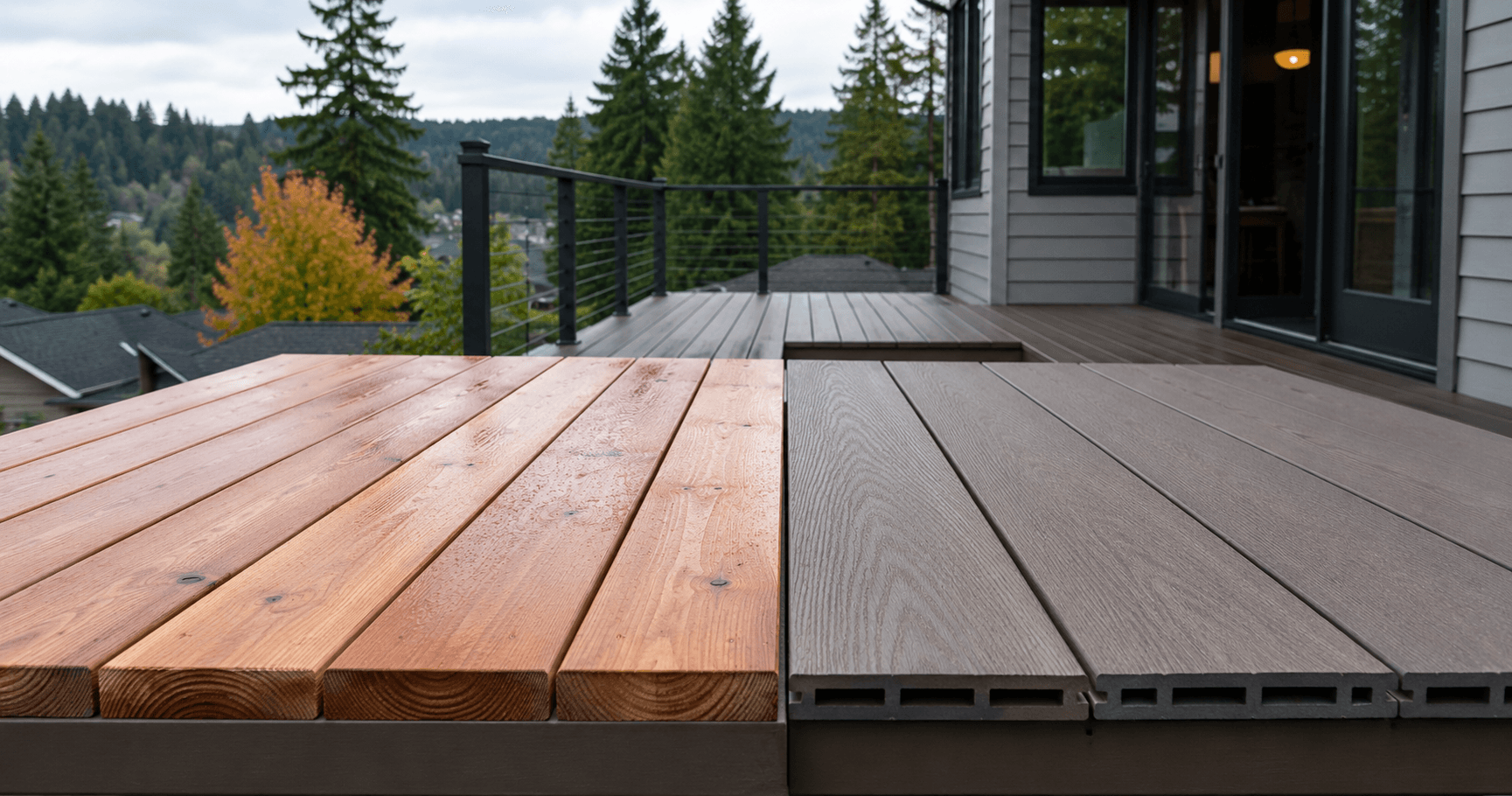
Composite vs. Cedar Decking in the Pacific Northwest
Published August 24, 2026
Cedar offers natural wood character, while composite decking reduces routine maintenance. The right choice depends on appearance, upkeep, budget, and how the deck will be used.
Choosing between composite and cedar decking in the Pacific Northwest usually comes down to one practical question:
How much maintenance do you want to do after the deck is built?
Both materials can make a good deck. They simply behave differently.
Cedar gives you real wood grain, natural color, and a surface that can be refinished as it ages. Composite gives you a more consistent appearance and much less routine finishing work.
In Seattle and the Eastside, moisture makes that decision more important. Decks spend months dealing with rain, shade, leaves, pine needles, algae, and surfaces that may take longer to dry.
The material matters, but so do drainage, flashing, framing, ventilation below the deck, and installation details.
Here is how the two options compare.
Composite vs. Cedar Decking at a Glance
Factor
Cedar
Composite
Appearance
Natural wood grain and variation
Consistent manufactured finish
Routine maintenance
Higher
Lower
Staining/sealing
Usually part of long-term upkeep
Generally not required
Moisture management
Needs good drainage and ability to dry
Surface handles moisture well, but framing still needs protection
Refinishing
Can be cleaned and refinished
Usually cleaned rather than sanded or refinished
Upfront cost
Often lower
Often higher
Long-term maintenance cost
Higher
Generally lower
Color changes
Naturally weathers over time
Depends on product and color
Best for
Natural wood look
Low-maintenance outdoor living
Neither material wins every category.
The better choice depends on what you value most.
Why the Pacific Northwest Changes the Comparison
A deck in the Seattle area does not live in the same conditions as a deck in a dry climate.
Rain is only part of it.
The bigger challenge is how long surfaces remain damp after the rain stops.
A deck surrounded by mature trees may receive less direct sun. Leaves and needles collect between boards or along edges. Furniture and planters can create areas that dry more slowly.
That makes drainage and drying important regardless of the decking material.
Even composite decking does not remove the need for proper construction underneath. The framing, ledger connection, flashing, fasteners, footings, and drainage details still have to manage Pacific Northwest moisture.
A premium deck board installed over poorly protected framing is still a poor deck system.
Cedar: Why Homeowners Still Choose Real Wood
Cedar has a look that manufactured decking is designed to imitate but cannot reproduce exactly.
Every board is slightly different.
The grain, knots, color variation, and way the wood ages are part of the appeal.
For homeowners who want a deck to feel connected to the surrounding landscape, cedar works especially well with Pacific Northwest architecture and wooded properties.
It can look at home beside evergreens, natural stone, wood siding, and older Seattle-area houses.
It is also repairable and refinishable in ways composite usually is not.
If a cedar surface becomes weathered, the wood can often be cleaned, prepared, and refinished rather than simply replaced because its appearance has changed.
But cedar asks more from the homeowner.
Cedar Requires Maintenance
Natural wood changes outdoors.
Sun, rain, moisture, dirt, mildew, algae, and foot traffic all affect its surface.
If you want cedar to retain more of its original color, you need to expect periodic cleaning and finish maintenance.
Western Red Cedar guidance recommends keeping deck surfaces clear of dirt, leaves, pine needles, and other debris and allowing the deck to dry after getting wet.
That is particularly relevant around Seattle.
A deck beneath trees can look clean from across the yard while debris is sitting between boards or under furniture, keeping sections wet.
Cedar maintenance may include:
removing leaves and debris;
cleaning dirt and organic buildup;
managing mildew or algae;
inspecting boards and fasteners;
maintaining proper drainage;
renewing a protective finish when needed.
If you enjoy the appearance of natural wood and do not mind that maintenance, cedar can be a very satisfying choice.
If you know that staining and refinishing will continually get pushed to “next year,” composite may fit your lifestyle better.
Composite: The Main Advantage Is Lower Maintenance
Composite decking is popular for a simple reason.
You do not have to treat it like a traditional wood deck.
Modern composite boards still need cleaning. Leaves, pollen, food spills, dirt, and organic debris should not be allowed to sit indefinitely.
But routine care is generally simpler.
High-performance composite products are normally cleaned with soap, water, and an appropriate brush or manufacturer-approved cleaning method rather than being repeatedly sanded and stained.
That makes a difference for homeowners who want to use the deck rather than plan regular refinishing projects around it.
Fine Element Construction currently works with deck materials including composite and cedar, and its deck service page specifically lists composite products from brands such as Trex and TimberTech among the available options.
Composite Is Not “No Maintenance”
This distinction matters.
Low maintenance does not mean no maintenance.
Composite decking still collects:
pollen;
dust;
leaves;
food residue;
tree debris;
organic material.
In damp and shaded areas, dirt sitting on the surface can contribute to unwanted biological growth.
The deck should still be swept and cleaned.
The difference is that routine maintenance normally focuses on cleaning rather than protecting exposed wood fibers with stain or sealer.
Always follow the cleaning instructions for the specific decking product you install.
Different composite generations and manufacturers can have different requirements.
What About Rain and Rot?
This is one of the biggest reasons composite appeals to Pacific Northwest homeowners.
The decking board itself is engineered differently from natural lumber and does not rely on the same type of exterior finish to protect exposed wood.
But homeowners sometimes take that benefit too far and assume the whole deck becomes moisture-proof.
It does not.
A deck includes far more than the walking surface.
The structure may still include:
wood framing;
joists;
beams;
posts;
ledger connections;
fasteners;
flashing;
footings.
Water management around those components still matters.
Good deck construction should allow water to drain and materials to dry instead of creating places where moisture remains trapped.
That is why the installation is just as important as choosing cedar or composite boards.
Appearance: Natural Variation vs. Consistency
This is mostly personal preference.
Cedar
Cedar gives you:
real grain;
natural variation;
changing color over time;
a traditional wood feel;
the option to stain the material in different tones.
Some homeowners like the way cedar weathers.
Others want to preserve its warmer original color.
Both are valid design choices, but the maintenance strategy should match the look you want.
Composite
Composite gives you greater consistency.
Boards can be selected in colors and textures designed to resemble different wood tones without the same variation from board to board.
That is useful when the goal is a cleaner, more contemporary outdoor space or when you want the deck color to coordinate closely with siding, railings, doors, or other exterior finishes.
Current products offer much more realistic texture than older generations of composite decking.
Still, it remains a manufactured surface.
If having actual wood underfoot is important to you, cedar has the advantage.
Which Material Is Easier to Repair?
This is one category where the differences are easy to overlook before construction.
Cedar can often be:
cleaned;
lightly prepared;
refinished;
repaired board by board;
restored when its surface becomes weathered.
Composite is handled differently.
Manufacturers generally do not recommend sanding composite decking because sanding can change the manufactured surface.
If a board becomes badly damaged, replacement of that board may be more appropriate than trying to refinish it as you would natural wood.
This is another reason proper installation matters.
Board spacing, fastening systems, access, and product availability can all affect how easy a future repair will be.
Which Decking Gets Hotter?
Surface temperature depends on more than whether the board is cedar or composite.
Color matters.
Sun exposure matters.
The specific composite product matters.
A dark deck in direct afternoon sun will generally behave differently from a lighter board on a shaded property.
If bare-foot comfort is important, especially on a south- or west-facing deck, compare physical material samples in sunlight rather than choosing only from photographs.
The same principle applies to color.
Outdoor light can make a board look very different from the small sample you saw indoors.
Upfront Cost vs. Long-Term Cost
Composite decking generally costs more upfront than cedar.
That does not automatically make cedar the less expensive deck over its entire life.
Wood requires more maintenance.
Cleaning products, stain, finish materials, and professional refinishing all have a cost. Your own time also has a value.
Composite shifts more of the expense toward initial construction and reduces the amount of ongoing finish work later.
This is why the most useful comparison is not simply:
“Which board costs less today?”
A better question is:
“What will owning this deck require from me over the next several years?”
The detailed cost comparison belongs in a project estimate because deck size, framing condition, stairs, railings, site access, design, and selected product line can change the budget substantially.
Cedar Makes Sense If...
Cedar may be the better choice when:
natural wood is part of the design;
you like real grain and color variation;
you are comfortable with periodic maintenance;
you want the ability to refinish the surface;
the deck complements a traditional or natural exterior;
you are comfortable with the way real wood changes as it ages.
The key is being realistic about maintenance before choosing it.
A cedar deck that receives appropriate care is very different from one that spends years covered with wet debris and receives no attention.
Composite Makes Sense If...
Composite may be the stronger fit when:
low maintenance is a priority;
you do not want regular staining;
consistent color matters;
you prefer a contemporary appearance;
the deck will be used heavily;
you want to spend less time maintaining exposed wood surfaces.
Fine Element's current Deck Building service specifically recommends composite options such as Trex or TimberTech for homeowners prioritizing low maintenance in Pacific Northwest conditions, while still offering cedar for clients who prefer natural wood.
Real Fine Element Deck Projects
Fine Element's current portfolio includes projects using both material approaches.
Kirkland Composite Deck Install
A Kirkland project used composite decking with integrated stairs and perimeter lighting.
That is a good example of where composite works well: a finished outdoor-living space designed around regular use and low surface maintenance.
Sammamish Cedar Deck Upgrade
The Fine Element portfolio also includes a cedar deck project in Sammamish where the deck footprint was expanded and railings were replaced.
Cedar fits naturally in a wooded Eastside setting and remains a strong choice when the homeowner wants real wood rather than a manufactured surface.
These are two different solutions, not a “good material versus bad material” comparison.
The material should match the house and the homeowner.
Don't Forget the Structure Under the Deck
People spend a lot of time comparing deck boards because that is what they see.
But the framing underneath determines whether the finished deck has a solid foundation.
A deck project may involve:
structural framing;
footings;
ledger attachment;
stairs;
landings;
railings;
flashing;
drainage details;
permits.
Replacing the visible boards without evaluating an older structure can miss problems underneath.
If an existing deck is being resurfaced, the framing should be assessed before new decking is installed.
If it is a completely new deck, material selection should happen as part of the full structural and design plan, not as a separate decision at the end.
So, Which Is Better for the Pacific Northwest?
For a homeowner who wants lower routine maintenance, composite is usually the easier fit.
For someone who wants real wood, natural variation, and the ability to refinish the surface, cedar remains an excellent option.
There is no reason to force the same answer on every property.
Think about:
how much maintenance you are willing to do;
the look you want;
sun and shade around the deck;
how heavily the deck will be used;
the condition of existing framing;
your upfront budget;
your longer-term ownership plans.
Those answers usually make the decision much clearer.
Deck Building in Seattle and the Eastside
Fine Element Construction builds and renovates decks throughout the Greater Seattle Area.
Its current deck service includes custom design and planning, permits, cedar or composite material selection, structural framing and footings, decking installation, railings, stairs, landings, and final walkthrough.
If you are comparing cedar and composite for a new deck or planning to replace an older one, start with the entire project rather than just the board sample.
Explore Fine Element Construction's deck building services.
The best material is the one that works with your home, your maintenance expectations, and the way you actually plan to use the space.